Transform your scientific imaging workflows with advanced computer vision. Our custom-developed systems analyse complex visual data with precision, whether you're studying microscopic structures or monitoring industrial processes. Each solution is tailored to your specific scientific domain.
Key capabilities
Object detection & counting
Accurate detection and counting of objects in complex scientific imagery. From cellular structures to industrial components, with precise quantification and confidence intervals. Automated counting reduces manual effort while maintaining scientific accuracy.
Visual interpretation
Understanding what your model sees is crucial for scientific validation. Attention visualisation, feature importance maps and uncertainty visualisation make the detection auditable rather than merely confident.
Synthetic data
Overcome limited-dataset problems with synthetic image generation. We create diverse, physically plausible images to strengthen training data, improving robustness and generalisation while keeping the physics honest.
Scalable processing
Automated pipelines for large-scale image analysis. From individual samples to batches of thousands, at consistent accuracy.
Integration & customisation
Solutions that fit your existing workflows and imaging equipment, whether that is a specialised microscope or an industrial camera.
Confidence in every detection
Each analysis carries uncertainty quantification, so you know the confidence level behind every prediction - not just the prediction.
Advanced analysis capabilities
We develop tailored solutions that integrate with your scientific workflows. Our expertise spans laboratory-scale experiments through to industrial implementations, always adapting to your specific needs. By combining scientific domain knowledge with AI expertise, we help research teams overcome complex challenges and accelerate discovery. Each solution is built from the ground up to match your requirements while maintaining scientific rigour.
A worked example
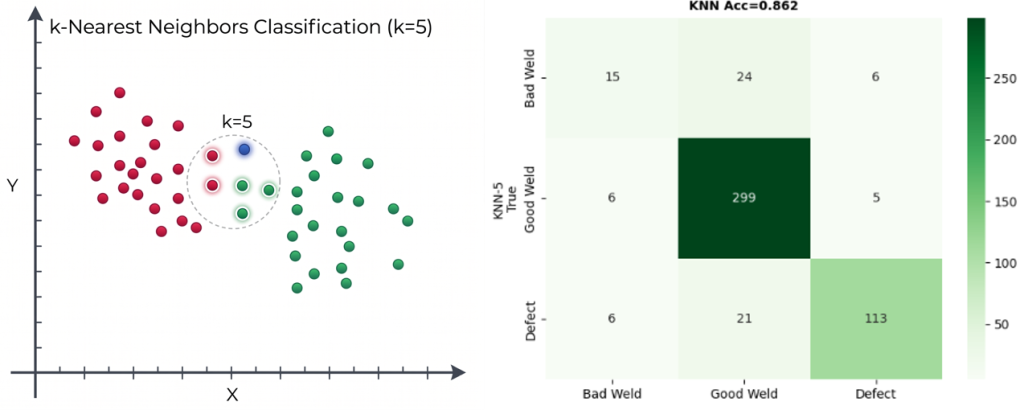
We took a foundation model trained only on steel micrographs and, without retraining it, ran a public welding dataset through it. It organised the images, supported semantic search across them, surfaced anomalies, and reached 86% accuracy on a three-class quality problem using nothing more than a nearest-neighbour vote - against a 63% majority-class baseline.
That is the kind of one-day feasibility check worth running before committing to a data collection programme.
Where it applies
Materials
Micrographs, surface inspection and anomaly detection on the production line.
Life sciences
Cell counting, pest and species identification, and analysis of video feeds.
Model deployment
Getting the detector off a workstation and into somewhere the team can actually use it.